Different products. One shared structure.
A technical catalog becomes useful when buyers can describe what they need and find relevant products without opening every datasheet. This becomes harder when information comes from several manufacturers: specifications have different names, measurements use different units, and important details remain buried in descriptions. Putting these products on the same website brings them together, but does not yet make them searchable or comparable.
The solution starts with giving products within each category a shared structure. This is where Actualog connects supplier information with the way buyers—and AI agents—select products.
Why search filters and comparison tables need the same foundation
Keyword search helps buyers find names and descriptions. Parametric search lets them filter products by technical requirements, such as housing material, connection size, or operating temperature. For this to work, the catalog needs identifiable characteristics with precise meanings and usable values. A description saying “stainless steel” cannot reliably satisfy a filter for stainless-steel housings when the supplier might be referring only to the impeller.
Comparison depends on exactly the same foundation. A row called “Housing material” must describe the housing of every product in the table. Numeric values need compatible units, and missing information must remain distinguishable from a confirmed value. Otherwise, a comparison table merely places inconsistent descriptions beside one another and leaves the buyer to interpret them. A shared category structure makes both filtering and comparison meaningful.
AI agents need those product facts too
An AI agent changes how buyers express their requirements, but it does not remove the need for product information. Instead of selecting filters, a buyer can describe a task in ordinary language and ask the agent for a shortlist. The agent still needs facts that establish whether each product matches. It may extract those facts from a datasheet, but when the available sources never state a required characteristic, it cannot reliably verify the match. A physically suitable product can therefore be absent from a trustworthy shortlist simply because its information is incomplete.
Structured characteristics give an agent explicit definitions, values, and units to work with, rather than forcing it to reconstruct everything from prose. That information also needs to be accessible through the catalog or an integration; storing it in an inaccessible database does not make it available to external agents.
How Actualog turns supplier information into usable product data
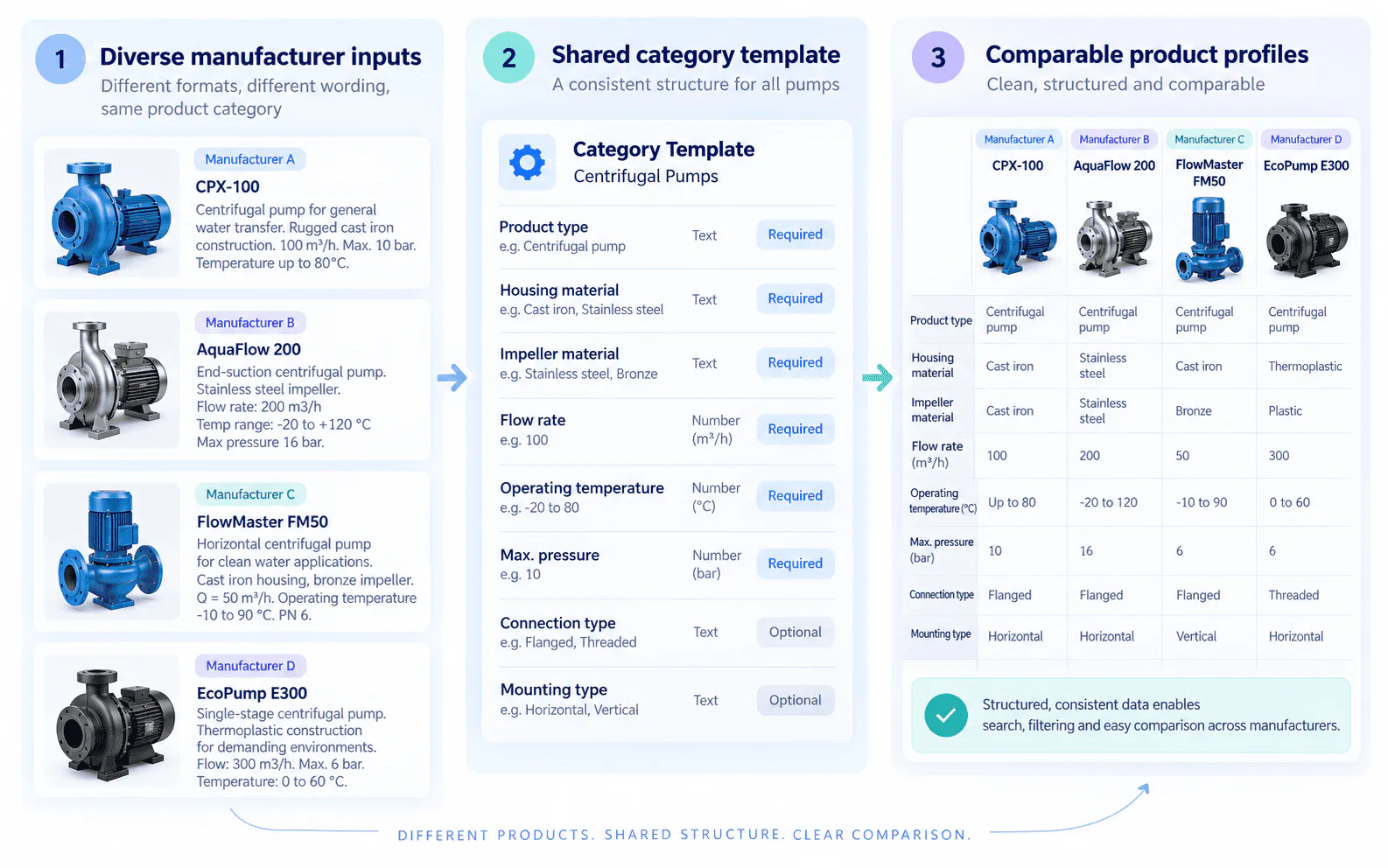
In Actualog, the work begins with a template for a specific product category. The template brings together shared attribute definitions, data types, units, permitted values, and requirements. Existing definitions can be reused across related categories, so the team does not rebuild the same technical vocabulary for every supplier. Supplier fields are then mapped to this structure: “Body material” and “Housing material” can refer to the same attribute when their definitions agree, while impeller material remains a separate characteristic.
Each distinct product retains its own Product Profile, including its manufacturer, model, actual specifications, images, and supporting documents. Different products are not merged. Their information is organized consistently so that they can participate in common search filters, comparisons, and multi-company catalogs. Template requirements also provide a reference for identifying missing information before a buyer needs it.
Actualog’s advantage is the connection between these layers: reusable product knowledge, category-specific requirements, individual Product Profiles, and catalogs built from those profiles. The team maintains a shared model instead of repeatedly reconciling supplier descriptions for each new catalog. For buyers, this creates a clearer path from technical requirements to a relevant shortlist. For AI-assisted selection, it establishes the structured information that connected agents need to assess the same products.